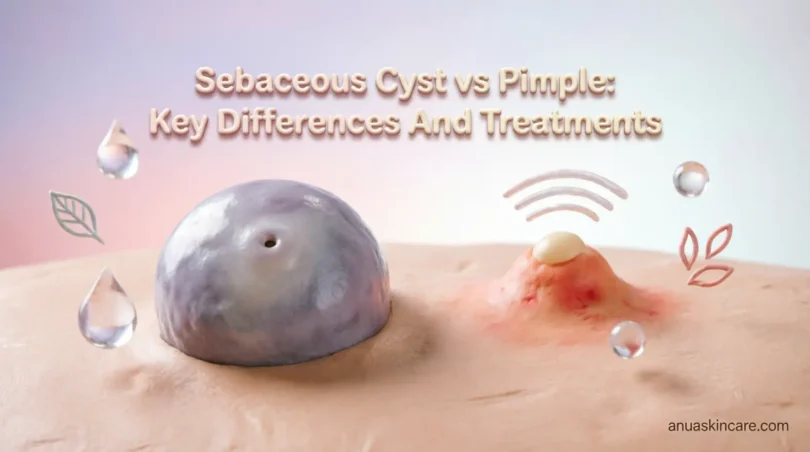

introduction
You wake up, look in the mirror, and there it is — a bump on your face, neck, or back. Your first instinct is probably to call it a pimple and move on. But what if it is not a pimple at all? What if that stubborn lump sitting under your skin is actually a sebaceous cyst? Understanding the difference between a sebaceous cyst vs pimple is more important than most people realize — and getting it wrong can make things significantly worse.
Millions of people confuse the two every single day, and that confusion leads to the wrong treatment, unnecessary scarring, and in some cases, a worsening infection. Knowing the difference between a cyst vs pimple is not just a matter of curiosity — it directly affects how you should respond to what your skin is telling you.
This guide breaks down everything you need to know: what each condition actually is, how to visually and physically tell them apart, when to worry, what treatments work, and the common mistakes people make when dealing with under skin cyst pimple situations.
What Is a Pimple and What Causes It
A pimple is a surface-level skin lesion that forms when a pore becomes blocked. Your skin constantly produces oil through sebaceous glands attached to hair follicles. When that oil, called sebum, mixes with dead skin cells and gets trapped inside a pore, it creates the perfect environment for bacteria to grow.
That bacterial activity triggers inflammation, which is what causes the redness, swelling, and tenderness you associate with a typical breakout.
Pimples fall under the broader umbrella of acne, and they come in several forms:
- Whiteheads: closed, clogged pores with a white tip visible at the surface
- Blackheads: open pores where oxidized sebum creates a dark appearance
- Papules: small, red, inflamed bumps without visible pus
- Pustules: red bumps with a white or yellow pus-filled center
- Nodules: large, painful, deep pimples that sit further beneath the skin
- Cystic acne: the most severe form, discussed in its own section below
Common triggers for acne and pimples include hormonal fluctuations, dietary factors, stress, certain medications, and genetics. Teenagers are disproportionately affected, but adults in their 30s, 40s, and beyond deal with acne as well.
What Is a Sebaceous Cyst and How Does It Form
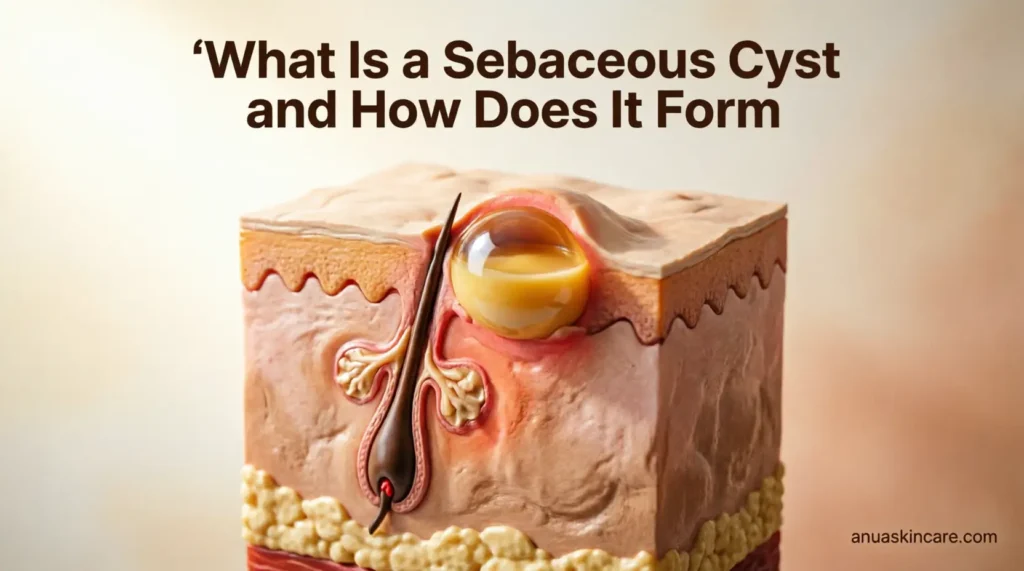
A sebaceous cyst is a closed sac that forms beneath the skin and fills with a thick, semi-solid material made primarily of keratin — the same protein found in your hair and nails. Despite the name, true sebaceous cysts are relatively rare. What most people and even some medical professionals casually call a sebaceous cyst is technically an epidermoid cyst or a pilar cyst. The term has stuck in popular use, so it is used broadly here.
These cysts develop when the sebaceous gland or its duct becomes damaged or blocked. The blockage traps secretions inside, and over time the material accumulates and forms a growing lump beneath the skin’s surface.
Unlike a pimple, a sebaceous cyst:
- Has no opening at the skin’s surface in most cases
- Grows slowly, sometimes over weeks, months, or years
- Does not resolve on its own the way a pimple typically does
- Contains a sac with a defined wall that must be removed to prevent regrowth
Causes include trauma to the skin such as cuts, scratches, or surgical wounds, damage from prior acne, blocked ducts, and in some cases genetic conditions like Gardner’s syndrome.
The most common locations are the scalp, face, neck, back, and shoulders — notably overlapping with where acne tends to occur, which is part of why the two are so frequently confused.
Cyst vs Pimple: Side-by-Side Comparison
| Feature | Pimple | Sebaceous Cyst |
|---|---|---|
| Location on skin | Surface or just below | Deep beneath the skin |
| Whitehead present | Often yes | Never |
| Size | Usually small, pea-sized or less | Often larger than a pea |
| Texture | Soft, fluid-filled or firm | Firm, dome-shaped, moveable |
| Pain | Mild to moderate when touched | Can be painful without touching |
| Duration | Days to a few weeks | Weeks, months, or years |
| Resolves on its own | Usually yes | Rarely without treatment |
| Responds to topical treatment | Yes | No |
| Risk if squeezed | Scarring, spreading | Deep infection, scarring |
| Requires surgery | No | Often yes |
How to Tell If It Is a Cyst or Pimple: The 5-Point Check

When you are staring at an unknown bump, run through these five checks before deciding how to handle it.
Check for a Whitehead
This is the fastest and most reliable visual clue. A pimple, particularly a pustule or whitehead, will have visible pus or a white tip at or near the skin’s surface. A sebaceous cyst will never develop a whitehead. If there is no surface opening and no visible tip after several days, you are likely looking at a cyst rather than a pimple.
Measure the Size
Most standard pimples are relatively small — typically a few millimeters in diameter. If the bump is larger than a pea and appears to be growing slowly over time rather than forming quickly overnight, that pattern is consistent with a cyst. Sebaceous cysts can grow to the size of a golf ball in extreme cases, though most are much smaller.
Feel the Texture and Mobility
Gently press around the bump, not on it. A pimple tends to be rooted in one spot and firm or fluid-filled depending on its stage. A sebaceous cyst typically feels like a firm, smooth dome beneath the skin and has a subtle mobility to it — meaning it shifts slightly when you press around it. This mobility is due to the defined sac structure sitting below the skin layers.
Note How Long It Has Been There
Pimples, even stubborn ones, generally go through a cycle of forming, peaking, and either draining or being reabsorbed within one to three weeks. If you have had a bump in the same location for more than a month with little to no change, it is almost certainly not a standard pimple. Long-lasting lumps are one of the defining characteristics of sebaceous cysts.
Assess the Pain Level
A pimple may be tender when pressed. A sebaceous cyst that has become inflamed or infected can cause significant pain without any physical contact at all. Spontaneous, unprovoked pain or warmth around a skin bump is a signal to take more seriously and have evaluated by a professional.
Understanding Cystic Acne vs Acne: A Common Source of Confusion
One reason people struggle with this topic is that even within the category of acne, there is a severe form called cystic acne that shares characteristics with sebaceous cysts. Sorting out cystic acne vs acne — and then cyst vs cystic acne — matters for treatment.
Regular Acne
Standard acne includes whiteheads, blackheads, and mild pustules. It typically sits at or near the skin surface and responds well to over-the-counter treatments. It is inflammatory but not deeply embedded.
Cystic Acne
Cystic acne is the most severe form of acne. It forms deep within the skin and involves large, painful, fluid-filled nodules. It does not resolve easily on its own, often leaves scars, and requires prescription treatment. It looks and feels more aggressive than typical breakouts.
Cyst vs Cystic Acne
Here is the key distinction: cystic acne is still acne. It is rooted in the same sebaceous overactivity and bacterial inflammation that drives all acne. A sebaceous cyst, however, is a structural abnormality — a sac that has formed beneath the skin. Cystic acne can resolve with medication. A sebaceous cyst generally cannot.
Both can be painful, both sit deep in the skin, and both can appear on the face, back, and neck. The difference is origin, composition, and treatment pathway. Cystic acne responds to isotretinoin and antibiotics; a sebaceous cyst typically requires surgical removal.
What Happens If You Try to Pop Either One
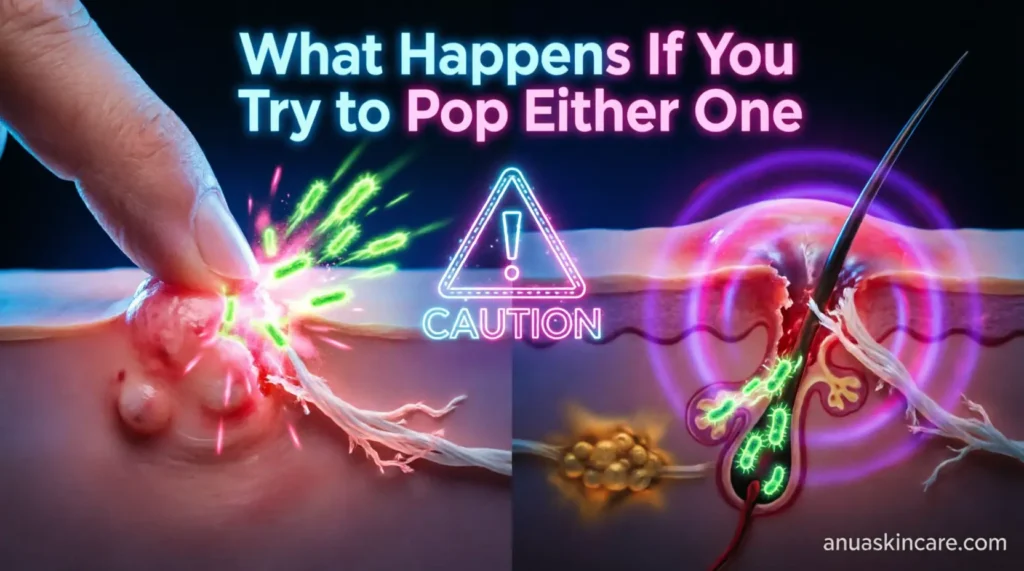
Most people already know you should not pop pimples, but it is worth explaining why attempting to pop a cyst or pimple causes specific harm in each case.
When you pop a pimple, you risk pushing bacteria and infected material deeper into the follicle, spreading inflammation to surrounding skin, introducing new bacteria from your fingers, and creating post-inflammatory hyperpigmentation or permanent scarring.
When you attempt to squeeze or pop a sebaceous cyst, the consequences are worse. Because the cyst has no surface opening, applying pressure forces the contents downward and outward within the tissue. This can rupture the cyst wall beneath the skin, cause a deeper infection, trigger an intense inflammatory response, and make surgical removal more complicated. Even if some material drains, the sac wall remains and the cyst will refill.
The bottom line: do not attempt to express or drain either one at home. With a cyst, it is especially important to resist this urge.
When a Bump Might Be Something Else Entirely
Not every lump is a pimple or a sebaceous cyst. There are several other skin conditions that can be mistaken for one or both, and some carry more serious implications.
Lipoma
A lipoma is a slow-growing, soft lump of fatty tissue just beneath the skin. It is almost always benign, painless, and moveable. Unlike a sebaceous cyst, it contains fat rather than keratin. It does not cause inflammation.
Boil (Furuncle)
A boil is a deep bacterial infection of a hair follicle. It starts as a red, tender area and progresses into a firm, painful lump that eventually fills with pus. Boils are more acutely painful than sebaceous cysts and tend to grow more rapidly.
Milia
Milia are tiny white cysts, usually 1 to 2 millimeters in diameter, that form when keratin becomes trapped near the surface of the skin. They look like small white pimples but have no pore opening. They are harmless and very common around the nose, cheeks, and eyes.
Pilonidal Cyst
These form near the tailbone and are distinct from sebaceous cysts. They are associated with ingrown hairs and can become severely infected.
When to Be Concerned About Cancer
The vast majority of skin cysts are benign. However, any lump that grows rapidly, feels hard and immovable, bleeds without cause, or is accompanied by systemic symptoms like fever warrants prompt medical evaluation. Dermatologists can perform ultrasounds, CT scans, or biopsies to rule out malignancy.
Treatment Options for Pimples vs Sebaceous Cysts
Treating Pimples and Acne
Mild to moderate acne responds well to consistent skincare and over-the-counter treatments. For more stubborn or inflammatory cases, a dermatologist can prescribe stronger options.
Over-the-counter options:
- Salicylic acid cleansers and toners to exfoliate and unclog pores
- Benzoyl peroxide to kill acne-causing bacteria
- Adapalene (topical retinoid) to regulate cell turnover
Prescription treatments:
- Topical or oral antibiotics such as tetracycline or doxycycline
- Prescription-strength retinoids
- Hormonal treatments including combined oral contraceptives or anti-androgen medications
- Isotretinoin for severe cystic acne
Professional procedures:
- Chemical peels
- Photodynamic therapy
- Extraction performed by a licensed aesthetician or dermatologist
- Corticosteroid injections for inflamed nodules
Treating Sebaceous Cysts
Over-the-counter creams and washes have no meaningful effect on sebaceous cysts because the problem is structural, not topical. Medical intervention is the only reliable path.
Treatment options include:
- Conventional wide excision: the entire cyst including its sac wall is surgically removed; most effective at preventing recurrence but may leave a scar
- Minimal excision: a smaller incision is made to remove the cyst with less tissue disruption and reduced scarring
- Laser-assisted excision with punch biopsy: a laser creates a small opening to drain and remove the cyst contents before the sac is extracted
- Steroid injection: used to reduce inflammation in an actively infected cyst before definitive removal
- Incision and drainage: provides temporary relief but does not prevent recurrence because the sac wall remains
Following any removal procedure, antibiotic ointment is typically recommended to prevent wound infection. Scar management creams may also be advised depending on the procedure used.
Sebaceous Cysts and Hormonal Connections in Women
One area that competitor articles consistently overlook is the hormonal dimension of sebaceous cysts, particularly in women. Sebaceous glands are highly sensitive to androgens — male hormones present in both men and women. When androgen levels are elevated, sebaceous glands produce more sebum, which increases the risk of both acne and cyst formation.
In women with hormonal imbalances, such as those with polycystic ovary syndrome (PCOS), sebaceous cysts and cystic acne can be recurring and treatment-resistant. Standard topical treatments and even surgical removal may not provide lasting relief if the hormonal root cause is not addressed.
In these cases, dermatologists may collaborate with endocrinologists or gynecologists to recommend anti-androgen medications such as spironolactone, or hormonal contraceptives that help regulate sebum production at the source. Simply removing a cyst without addressing the hormonal environment is like fixing a leak without turning off the water.
Lifestyle and Prevention: What You Can Actually Control

Neither sebaceous cysts nor acne are entirely preventable, but certain habits meaningfully reduce your risk of developing either condition or worsening an existing one.
For reducing acne:
- Cleanse your face twice daily with a gentle, non-comedogenic cleanser
- Avoid touching your face throughout the day
- Change pillowcases frequently to reduce bacteria exposure
- Manage stress through sleep, exercise, and mindfulness
- Limit high-glycemic foods and dairy, which some research associates with increased acne severity
- Never pick or squeeze existing breakouts
For reducing sebaceous cyst risk and recurrence:
- Treat acne promptly to prevent the follicular damage that can lead to cyst formation
- Protect skin from trauma, cuts, and abrasions when possible
- If you are prone to cysts, discuss preventive options with your dermatologist before cysts become large or infected
- Do not attempt to drain or express cysts at home, as this increases scarring and infection risk
Scarring: How Cysts and Pimples Affect Your Skin Long Term
One of the most significant long-term consequences of both conditions is scarring, and the mechanisms are different for each.
Acne scarring typically results from the inflammatory response destroying collagen in the dermis. The more severe the inflammation and the more a breakout is picked or squeezed, the deeper the potential scarring. Common acne scar types include icepick scars, boxcar scars, rolling scars, and post-inflammatory hyperpigmentation.
Sebaceous cyst scarring results either from the cyst itself stretching and damaging surrounding tissue as it grows, or from the treatment used to remove it. Wide excisions leave the most visible scars. Minimal excision and laser techniques are specifically designed to minimize this.
Effective scar treatments include topical retinoids, silicone gel sheets, laser resurfacing, microneedling, and chemical peels. These are most effective when started early, before scarring becomes deeply established.
Frequently Asked Questions
Can a pimple turn into a sebaceous cyst?
Not exactly. A pimple cannot transform into a cyst. However, repeated or severe acne can damage the hair follicle and surrounding glandular tissue in ways that eventually lead to cyst formation. They are distinct conditions, but acne is considered a primary risk factor for developing sebaceous cysts in the same location over time.
Is a sebaceous cyst dangerous?
Most sebaceous cysts are benign and not medically dangerous. However, an infected cyst can become painful, swell significantly, and require urgent drainage. In rare cases, a cyst may develop into a more serious abscess. Any rapidly growing or unusually hard lump should be evaluated to rule out malignancy.
Can sebaceous cysts go away on their own?
Occasionally a small, uninflamed cyst may reduce in size temporarily, but true resolution without treatment is rare. Unlike pimples, sebaceous cysts do not have a natural resolution pathway. The sac wall remains intact beneath the skin even if some fluid escapes.
How do I know if my cyst is infected?
Signs of infection include rapidly increasing size, redness spreading around the bump, warmth to the touch, significant pain, and drainage of foul-smelling material. Fever is a sign the infection may have spread systemically and requires immediate medical attention.
What is the difference between cystic acne and a sebaceous cyst?
Cystic acne is a form of severe inflammatory acne. It is rooted in bacterial infection and sebum overproduction and responds to medications like isotretinoin. A sebaceous cyst is a structural sac beneath the skin filled with keratin. It does not respond to acne medications and typically requires surgical removal.
Should I see a doctor or a dermatologist?
For any growth that is large, painful, persistent beyond a few weeks, rapidly growing, or located near sensitive areas, a dermatologist is the appropriate specialist. They can provide a definitive diagnosis and discuss the most appropriate treatment plan for your specific case.
Can diet affect sebaceous cysts?
The direct link between diet and cyst formation is not well established in research. However, diet does influence hormonal fluctuations and sebum production, which are upstream factors in both acne and cyst development. A diet that keeps blood sugar stable and reduces inflammation is generally beneficial for skin health.
Conclusion
There is a meaningful difference between a cyst or pimple, and that difference is not just academic — it determines whether your skin needs a gentle cleanser or a surgical procedure. Pimples are surface-level, inflammation-driven, and generally manageable. Sebaceous cysts are structural, deep, and persistent.
If a bump on your skin has no whitehead, has been present for more than a few weeks, moves slightly under the skin, and does not respond to anything you try, stop treating it like a pimple. The skin is one of the most complex organs in the body, and what appears to be a minor cosmetic issue can sometimes signal something that deserves real attention.
The most honest piece of advice here is not about any particular cream or home remedy — it is this: do not let embarrassment or assumption delay a conversation with a dermatologist. Most skin conditions, whether a stubborn pimple or a sebaceous cyst, become far easier to manage when caught and addressed early. Your skin is worth treating with the same seriousness as any other part of your health.
You Might Also Enjoy Reading :
Skincare Rutina: The Ultimate Guide for Healthy Skin
Best Serum for Redness Prone Skin: Top Calming Serums 2026
Neumi Skin Review 2026: Benefits, Side Effects & Real Truth