introducton
Skincare brands live and die by their visuals. A single scroll-stopping image can move a customer from curiosity to checkout faster than any caption ever could. But pulling off a skincare ad campaign photoshoot that genuinely converts takes more than a ring light and a clean backdrop.
This guide breaks down the most effective skincare ad campaign photoshoot ideas being used by top beauty brands right now, along with the creative product photography techniques, styling approaches, and execution details that separate forgettable content from campaigns people actually remember.
Whether you are a brand owner planning your first product shoot or a photographer looking to expand your skincare portfolio, everything you need is here.
Why Skincare Ad Campaign Photography Is Uniquely Challenging
Skincare product photography sits at the intersection of technical precision and storytelling. Unlike fashion or food, skincare sells invisible promises: hydration, clarity, youth, glow. Your images have to make those promises feel real and believable.
The challenges are specific:
- Reflective packaging in glass, metal, and acrylic all behave differently under light
- Product textures like serums, creams, and gels need to feel tactile through a flat screen
- Models must look genuinely radiant, not retouched beyond recognition
- Ingredients, water, and motion elements introduce unpredictable variables on set
- Every asset must work across multiple placements: paid ads, organic social, ecommerce listings, and print
Understanding these challenges before you shoot is what separates a planned campaign from an expensive reshoot.
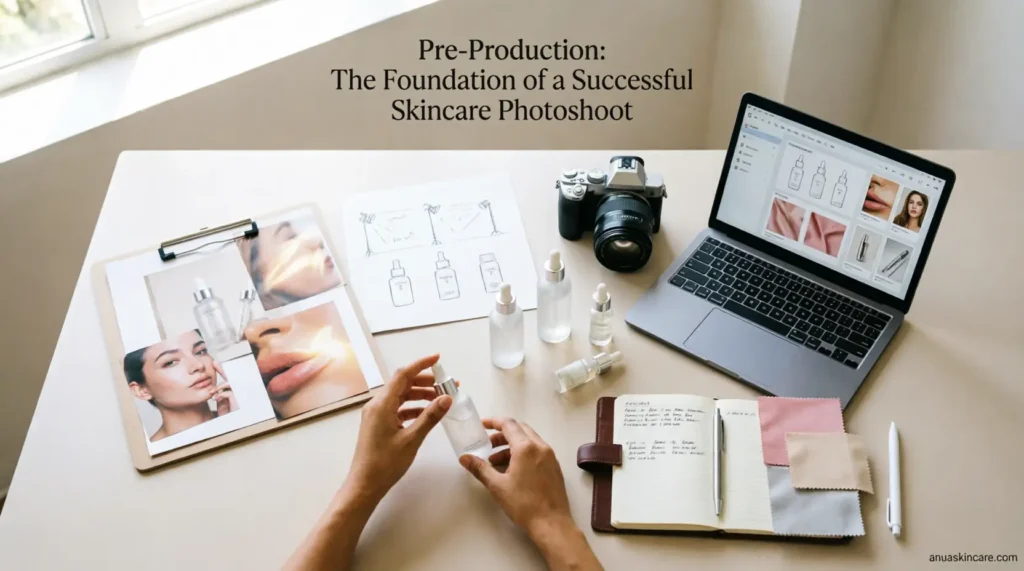
Pre-Production: The Foundation of a Successful Skincare Photoshoot
Build a Shot List Around Campaign Goals
Every skincare photoshoot needs a defined shot list before anyone touches a camera. Map each image back to where it will live. A hero shot for a paid ad needs different framing than a texture close-up for a product detail page. An Instagram story asset needs a vertical crop in mind from the start.
Group your shots into categories:
- Hero campaign images for ads and landing pages
- Product-only shots for ecommerce and retailer listings
- Texture and detail close-ups for ingredient storytelling
- Lifestyle and model shots for social and editorial
- Group or regimen shots for upselling and bundling
Align Visual Style With Brand Identity
Before choosing props, lighting, or backgrounds, nail down the visual language of the brand. A clinical dermatologist-endorsed serum should not look the same as a botanical wellness line. Pull a mood board. Define the color palette. Clarify whether the campaign tone is minimal and medical, warm and earthy, luxurious and editorial, or bold and disruptive.
Your background choices, prop selection, model casting, and lighting setups all flow from this decision.
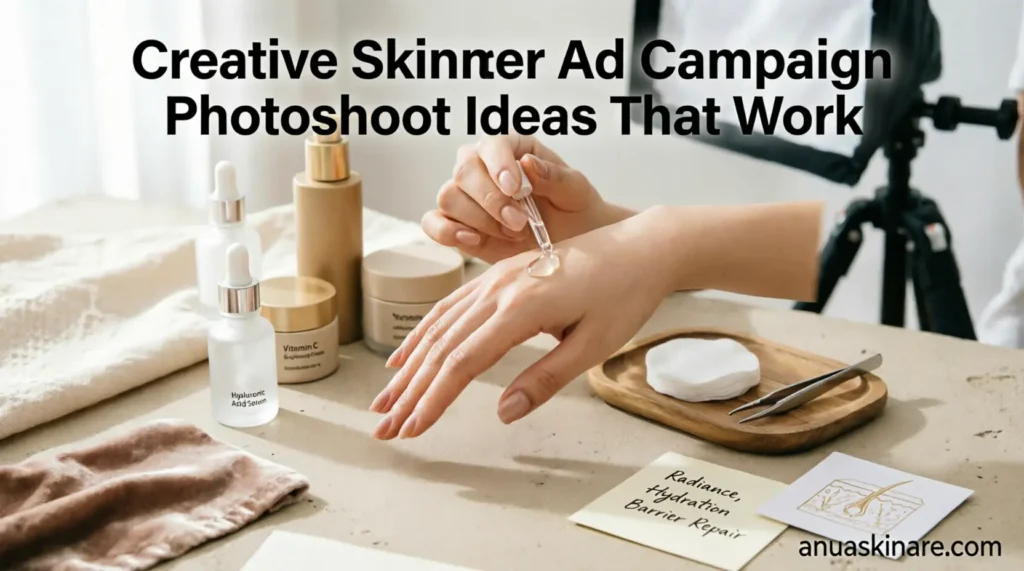
Creative Skincare Ad Campaign Photoshoot Ideas That Work
The Ingredient Story Concept
One of the most powerful skincare photography concepts available to any brand is the ingredient story. Consumers today want transparency. They want to know what is inside the bottle and where it came from.
Show them.
Surround the product with its hero ingredients in their natural form. A vitamin C serum paired with halved oranges on a sun-drenched white surface. A rosehip oil flanked by dried rose petals on warm terracotta. An aloe vera gel photographed against fresh-cut aloe stalks dripping with sap.
This concept works for several reasons. It creates an immediate visual association between the formula and its natural source. It signals ingredient quality without a single word of copy. And it gives the product context that builds trust with ingredient-conscious shoppers.
Execution tips:
- Keep props proportional so the product remains the clear focal point
- Use fresh ingredients on shoot day since wilting or browning kills the organic feel fast
- Shoot close-up detail frames of the ingredients separately for cropping flexibility
The Water and Freshness Campaign
Water is one of the most used and most misused elements in skincare photography. When it works, it signals hydration, purity, and vitality in a single frame. When it goes wrong, it looks messy and unintentional.
The key is control. Splashing water requires a fast shutter speed, typically 1/1000 or faster, and multiple takes. The post-production work is substantial. But the final asset, a moisturizer mid-splash with clean water arcing around it, reads as premium and energetic in paid ad placements.
For brands that want the freshness signal without the chaos of a water splash setup, consider:
- Products placed on a wet reflective surface with subtle pooling around the base
- Condensation beads on glass packaging shot in macro
- Ice, mist, or frost elements used as props to evoke cooling and hydration
The Texture Close-Up Concept
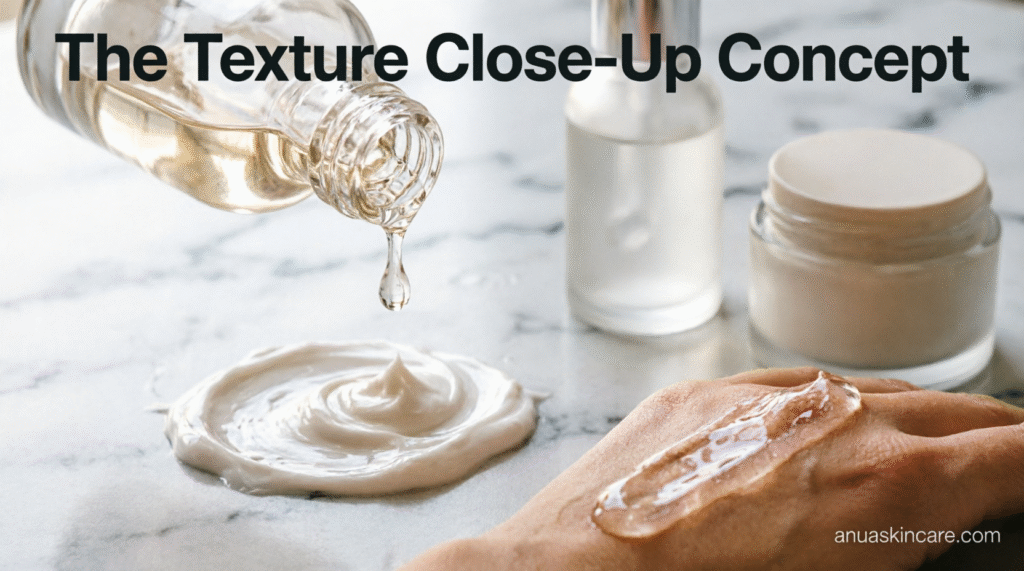
Texture sells skincare in a way that full product shots simply cannot. When a shopper can almost feel the silky slip of a serum or the rich drag of a night cream through their screen, purchase confidence goes up.
This concept requires a macro lens and intentional lighting. Scrape product onto a clean surface and shape it deliberately. The classic teardrop is reliable because the tapered tail shows both body and spreadability. But you can push further: spiral swirls for a playful brand, a clean flat smear on dark background for a clinical aesthetic, or textured dollops on skin for lifestyle context.
Surfaces that photograph well for smear shots:
- Frosted glass
- Marble or stone
- Matte black acrylic
- The back of a clean hand under controlled lighting
- Translucent film backlit with a soft source
The Minimalist Hero Shot
Sometimes the most persuasive skincare ad image is the simplest one. A single product on a seamless white or soft grey background, lit to perfection, with a reflective shadow beneath it. Clean, confident, brand-forward.
This approach demands technical execution because there is nowhere to hide. The lighting has to eliminate harsh shadows while keeping the packaging’s reflective surfaces readable. Post-production cleanup must be invisible. The product placement and angle must feel intentional.
For premium positioning, the minimalist hero shot communicates that the brand does not need to try hard. The product speaks for itself.
Background surfaces that work:
- White seamless paper
- Grey or warm-toned linen for organic brands
- Marble for luxury positioning
- Matte acrylic in brand-matched pastels
The Lifestyle Integration Concept
Lifestyle shots place the product inside a recognizable daily ritual. A bottle of toner on a marble countertop beside a running faucet. A moisturizer on a bedside table in morning light. Sunscreen being pressed into the back of a hand at the beach.
These images work because they answer the customer’s subconscious question: where does this fit in my life? When the setting and context match the target customer’s aspirational version of their own routine, the product becomes part of that aspiration.
Common lifestyle settings for skincare campaigns:
- Bathroom counters with curated accessories
- Vanity tables with mirrors and soft lighting
- Outdoor settings for SPF and mineral suncare products
- Wellness spaces like yoga rooms or bath setups for self-care positioning
The Levitation and Motion Concept
Products that appear to float or fall mid-frame create an automatic scroll-stop. Levitation shots using fishing line or fine wire, with the rigging removed in post, give skincare imagery a dynamic energy that static placement cannot achieve.
Dropping a bottle of serum from a low height and shooting at high speed to freeze it mid-fall is another variation. Pouring product from the bottle in a controlled stream is another.
Motion signals life. It suggests that the product is active, effective, and worth attention. In ad placements where you have under two seconds to stop a scroll, this matters.
The Packaging as Art Direction Concept
Premium skincare packaging is frequently designed with as much care as the formula inside. The photoshoot should treat it accordingly.
Stack multiple units to create architectural geometry. Shoot from directly above to create a flat lay that reads as editorial. Angle the box so it catches directional light and the embossing becomes visible. Use reflections and shadows as deliberate design elements rather than problems to fix.
For brands where the unboxing moment is part of the value, showing the packaging in context, tissue paper, ribbon, the inner tray, can be a campaign asset in itself, particularly for paid social targeting gift-givers.
Lighting Setups for Skincare Photography
Soft Diffused Lighting for Skin and Cream Textures
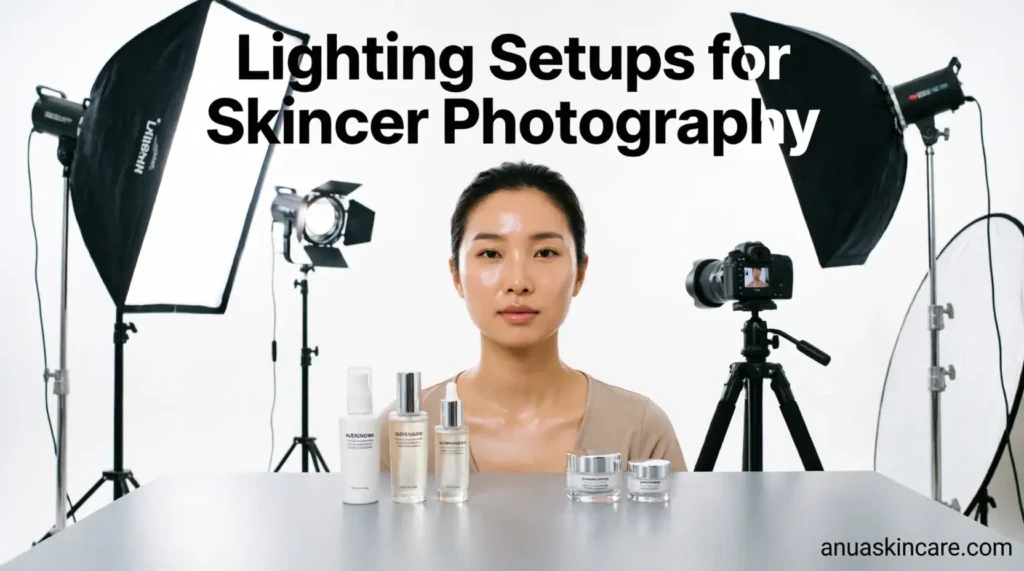
Soft, diffused lighting remains the default for most skincare photography because it flatters skin, minimizes harsh shadows on reflective packaging, and creates a calm, trustworthy atmosphere that matches the category.
Achieve this with a large softbox positioned slightly above and to the side of the product, with a reflector or fill card on the opposite side to lift shadows. The ratio between key and fill determines whether the image reads as bright and airy or moody and editorial.
Hard Directional Lighting for Drama and Depth
When a campaign needs edge, hard directional lighting delivers it. A single focused source from the side can carve shadows across packaging, give a cream texture dramatic depth, and turn a clinical set into something closer to fashion photography.
This approach works well for brands targeting a younger, trend-conscious audience or positioning against clean beauty mass market competitors.
Backlit Setups for Transparent Products
Serums, oils, and toners that come in clear or translucent packaging become luminous when lit from behind. The light passes through the liquid and glows, making the product look alive and potent. This is a technique borrowed from beverage photography that works exceptionally well in skincare.
Model and Skin Direction for Skincare Ad Campaigns
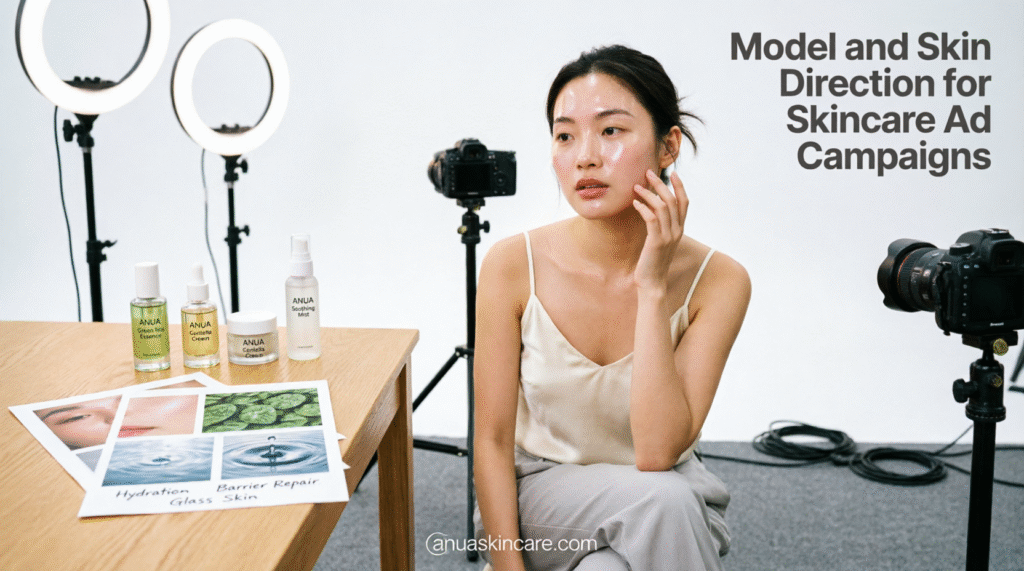
Cast for the Target Customer, Not General Beauty
The model in a skincare campaign is a direct message to the target customer: this product is for someone who looks like you, lives like you, and has skin concerns like yours. Casting the wrong model, even if they are objectively striking, disconnects the ad from its audience.
Anti-aging campaigns need models in the relevant age range with believable skin. Teen acne treatments need teenage models. SPF campaigns for outdoor lifestyles need models who look like they spend time outside, not in a studio.
Skin Prep and Direction on Set
Even the most naturally glowing skin needs preparation before a close-up skincare shoot. A makeup artist who specializes in skin and can work with the photographer to achieve the look the brand needs, dewy, matte, glass, or bare, is essential for model-led campaigns.
Direction during the shoot matters as much as casting. How the model holds their face, the angle of their neck, whether their eyes are open, closed, or looking away, all communicate different emotional states. Brief your model on the campaign story, not just the poses.
Creative Product Photography Ideas at Home for Small Skincare Brands
Not every campaign requires a full studio. Many of the most effective skincare product photography ideas can be executed with controlled natural light, a few basic surfaces, and some intentional prop selection.
What you need for a strong home setup:
- A window with consistent north-facing or diffused indirect light
- A clean white foam board or reflector card as a fill
- Two or three background options: white card, a marble tile, a piece of linen fabric
- A macro lens or close-up attachment for texture shots
- A piece of glass or acrylic sheet for reflective surface shots
Concepts that work well without a studio:
- Ingredient flat lays using kitchen surfaces and natural props
- Minimalist single-product shots on window-lit white backgrounds
- Texture smears on tile or glass surfaces
- Lifestyle setups on a bathroom counter or vanity table
The limitation of home setups is consistency, both across a shoot day and across different shoot dates. If your product line grows and you need to add images later, matching the lighting and aesthetic becomes difficult without a controlled environment.
Comparison: Skincare Photography Styles and When to Use Each
| Photography Style | Best Platform Use | Brand Positioning | Difficulty Level | Budget Range |
|---|---|---|---|---|
| Minimalist hero shot | Ecommerce, paid search ads | Premium, clinical, luxury | Moderate | Low to medium |
| Ingredient storytelling | Organic social, editorial | Natural, transparent, wellness | Low to moderate | Low |
| Texture close-up | Product detail pages, Instagram | Quality-focused, any tier | Low | Low |
| Water and splash | Campaign hero, video ads | Fresh, energetic, mass-premium | High | Medium to high |
| Lifestyle with model | Paid social, brand video | Aspirational, relatable | High | High |
| Levitation or motion | Paid social, awareness campaigns | Modern, disruptive | Moderate | Medium |
| Flat lay group shot | Email, landing pages, social | Complete routines, gift sets | Low | Low |
| Seasonal themed | Social campaigns, retail | Relevant, trend-responsive | Moderate | Medium |
Content Gap: Ad Creative Strategy for Skincare Photoshoots
Most guides on skincare photography stop at the creative execution. What they miss is the connection between how you shoot and how you run ads.
Shoot for Multiple Ad Formats Simultaneously
A single product photoshoot should produce assets in at least three formats: square, landscape, and vertical. If you are running Meta ads, you need 1:1 and 9:16. If you are running Google Display, you need 1.91:1. Plan your framing and compositions on set to accommodate all of these without relying on crops that cut off product or props.
Shoot for Testing, Not Just Aesthetics
Effective paid social for skincare requires creative testing. This means you need variations. Shoot the same product against two different backgrounds. Shoot with and without a model. Shoot the packaging alone and with ingredients. Shoot a texture close-up version and a lifestyle version.
The image that wins in a split test is rarely the one the photographer or brand director preferred on set. Shoot enough raw assets to have real options when you get into the ad account.
Shoot Static and Video in the Same Session
Video content for skincare ads, even simple six-second clips of water pouring or product being applied, consistently outperforms static in certain placements. If you have the setup for a water splash or motion shot, shoot stills and video in the same session. The marginal cost of adding a few video captures is low compared to the ad performance upside.
Post-Production Details That Elevate Skincare Campaign Images
Shooting is half the work. What happens in post-production determines whether the image reads as professional or amateur.
Essential retouching for skincare product photography:
- Clipping paths and background removal for clean ecommerce isolation
- Reflective shadow creation for products that lack a natural ground shadow
- Packaging text and label legibility cleanup
- Skin retouching that enhances without erasing natural texture
- Color grading that keeps product colors accurate across devices
- Consistency across a range of images so the full set looks cohesive
The reflective shadow deserves specific attention. It is one of the details that most distinguishes a professionally finished skincare product image from an amateur one, and it is not something that happens automatically in camera. It requires intentional construction in post using mirror layers and masking.
Seasonal and Campaign-Specific Photoshoot Planning
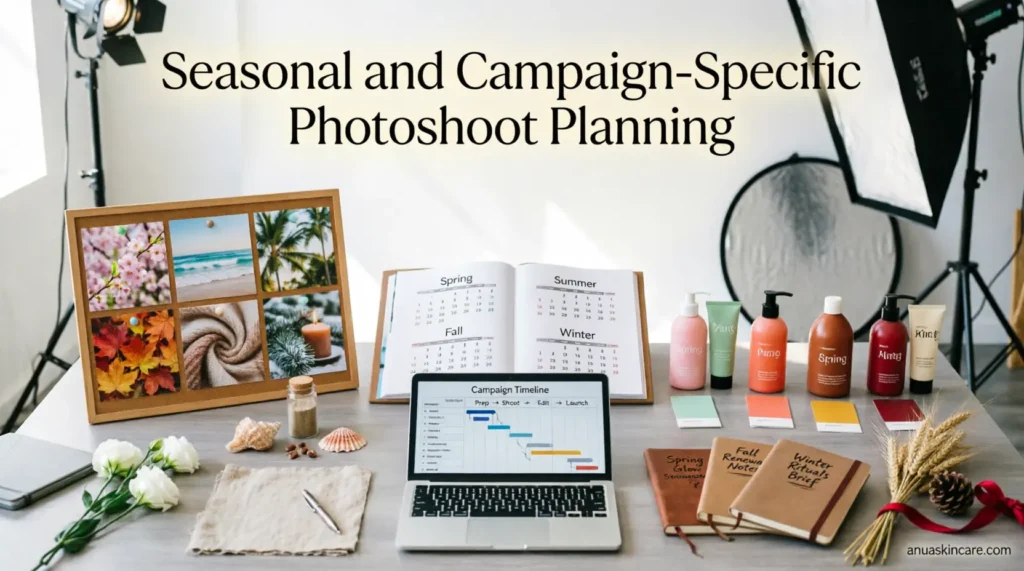
Skincare has a clear seasonal rhythm. SPF campaigns ramp into summer. Hydration and barrier repair campaigns perform through winter. Holiday gift sets need campaign assets in Q3 to be ready for retail and paid placements in Q4.
Build your photoshoot calendar around this rhythm. Trying to shoot a summer SPF campaign in July when the campaign needed to launch in June is a recurring problem for brands that do not plan creative production far enough in advance.
Seasonal concept pairings:
- Summer: water, citrus, outdoor lifestyle, bright saturated backgrounds
- Autumn: warm tones, textural props like leaves and wood, golden hour lighting
- Winter: cool tones, steam and warmth, cozy bathroom lifestyle, holiday packaging
- Spring: florals, soft pastels, fresh ingredient props, renewal themes
Frequently Asked Questions
What makes a skincare photoshoot work for paid ads specifically?
Paid ad creative for skincare needs to stop a scroll in under two seconds, communicate a clear benefit, and feel native to the platform it appears on. This means you need contrast, either color contrast or compositional contrast, in the hero image. The product needs to be immediately identifiable. And the image should not look like a stock photo or an obvious ad if you are running it in a social feed.
How many images should a skincare brand shoot in one session?
A well-planned skincare campaign shoot should produce a minimum of 20 to 30 final usable images across formats, concepts, and crops. Brands running active paid social campaigns need more. A rule of thumb is to plan for creative refresh every four to six weeks, which means new assets on a regular cycle.
Do I need a professional photographer for skincare ad campaigns?
For hero campaign images and paid ad creative, professional photography is strongly recommended. Skincare is a category where image quality directly affects perceived product quality and price anchoring. Amateur-looking images can actively hurt conversion rates for premium products. For supplementary content, organic social filler, and behind-the-scenes content, in-house or creator-produced content is viable.
What camera settings are best for skincare product photography?
For product-only shots, a small aperture between f/8 and f/11 gives sharp focus across the whole product. For texture close-ups where you want a shallow depth of field, open to f/2.8 or f/4. For water and motion shots, shutter speed of 1/1000 or faster freezes movement cleanly. Use ISO as low as possible to avoid grain in flat surface shots.
How do you photograph glass and reflective skincare packaging?
Glass and reflective metal packaging require flag diffusion panels around the product to prevent the camera and studio from reflecting in the surface. Large softboxes positioned at wide angles to the product flatten unwanted reflections. White cards placed strategically around the product add controlled highlights to the edges of the packaging. This is one of the most technically demanding aspects of skincare photography and often requires post-production refinement regardless of how well it is handled on set.
Can skincare photography be done at home with good results?
Yes, for specific shot types. Ingredient flats lays, minimalist white background shots, and texture close-ups can all be executed at home with natural window light and basic equipment. Model-led shots, water splash concepts, and high-production hero campaign images require a controlled environment and professional equipment to achieve the quality level that works in paid advertising.
What props work best for skincare photoshoots?
The best props for skincare photography are ones that reinforce the product’s core ingredients or brand positioning without distracting from the product itself. Natural elements like fresh botanicals, stones, wood surfaces, and ceramic vessels work across many skincare aesthetics. Avoid generic beauty props like roses and pearls unless they are genuinely connected to the brand story, as they read as generic rather than editorial.
Conclusion
A skincare ad campaign photoshoot is not a single event. It is a system of decisions, from creative concept and casting to lighting execution and post-production, that either builds a brand or quietly erodes it one mediocre image at a time.
The brands that consistently produce skincare photography that converts are not necessarily the ones with the biggest budgets. They are the ones that plan with intention, understand the technical demands of the category, and treat every shot list as a strategic document, not just a creative wishlist.
Use the concepts, lighting approaches, and execution details in this guide as a starting framework. Then test, iterate, and build a library of visual assets that grows smarter with every shoot.